Showing posts with label old. Show all posts

Monday, November 23, 2015

The Inscription of King Mānadeva at Changu Narayan - Theodore Riccardi, Jr.


Author: Theodore Riccardi, Jr.
Journal: Journal of the American Oriental Society
Volume: 109
Number: 4 
Date: October - December 1989
Page Number: 611-620
DOI: 10.2307/604086
Page Count: 10

Abstract:

The oldest dated inscription in the Kathmandu Valley, originally brought to light by Bhagvanlal Indraji and later by Sylvain Lévi, is inscribed on a stone pillar at the temple of Changu Narayan. This article provides the text, a new translation, and new photographs of the inscription.


For Citations:

APA Style
Riccardi, T.. (1989). The Inscription of King Mānadeva at Changu Narayan. Journal of the American Oriental Society109(4), 611–620. http://doi.org/10.2307/604086

MLA Style
Riccardi, Theodore. “The Inscription of King Mānadeva at Changu Narayan”. Journal of the American Oriental Society 109.4 (1989): 611–620.

Sunday, November 15, 2015

Monday, November 2, 2015

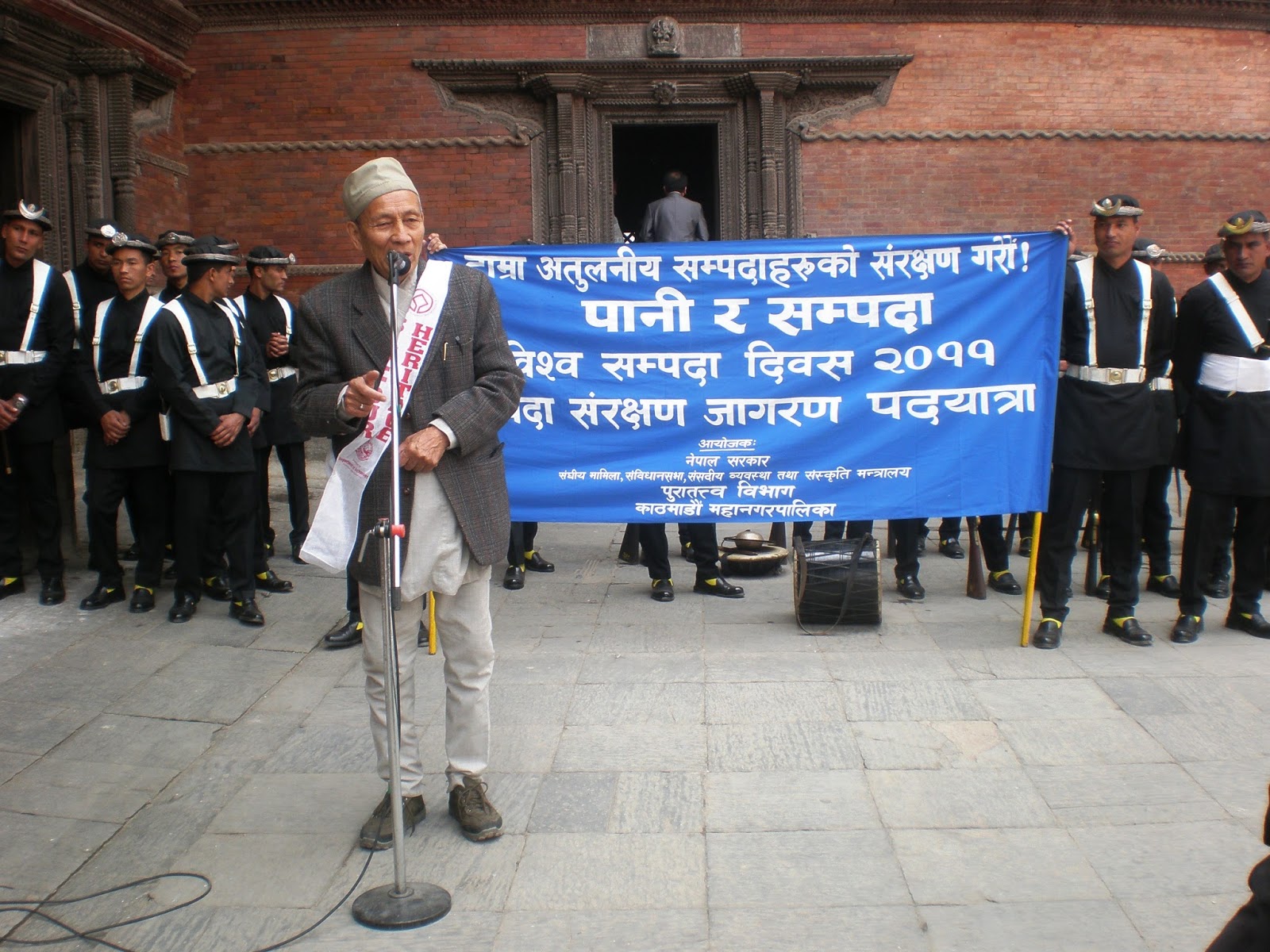
Celebrating World Heritage Day 2011 in Nepal

With focus on water heritages, World Heritage Day 2011 was celebrated on 18 April 2011 in Nepal.

The program was organized by:
- Department of Archeology, Ministry of Federal Affairs, Constituent Assembly, Constitutional Affairs and Culture (MoFACACAC) under Government of Nepal
- Kathmandu Metropolitan City

Satya Mohan Joshi addresses the World Heritage Day 2011 program
at Nasal Chowk in Hanumandhoka Durbar Square

Photo: Abhas D Rajopadhyaya, 2011, Kathmandu.

The man of the century (शताब्दी पुरुष) and veteran culture-expert of Nepal, Satya Mohan Joshi (aged 97) addresses the program.

Sunday, October 18, 2015

Narasiṃha Dance at Kārtik Ḍabalī - 1965 AD

.


Narasiṃha Dance being performed at
Kārtik Ḍabalī at Maṅgalbazār, Lalitpur in 1965 AD.

ललितपुरको मङ्गलबजारस्थित कार्तिक डबलीमा  नरसिंह नाच (वि.सं. २०२२)

Photo Courtesy: Kartik Nach Promotion Committee / Memory Zone


Kārtik Dance, called Kati Pyākha(n) (कति प्याखँ) in Newārī language, is one of the most popular masked dance since the late Middle Ages. Its history dates back to King Siddhi Narsiṁha Malla of Lalitpur.

Over a period of over 350 years, Kārtik Dance has seen a lot of changes. Now, Kārtik Dance is a 7-day long theatrical performance, and has recently been extended to 10-days. 

In the above photograph, Lord Narasiṁha is seen .

The performers in the above photograph are:

Narasiṁha = Pundit Chakradhar Sharma of Mahadyanani, Lalitpur
Hiraṇyakaśyapu = Maniklal Chitrakar

This photograph dates back to 1965 AD.

Thursday, October 1, 2015

Katuwal Karaune


A traditional Katuwāl from Myāgdī district, Nepal. 
Photo Courtesy: Annapurna Post

Katuwāl Karāune (shouters of Katuwāl caste) is one traditional means of communication in Nepāl.

Katuwāls would often go to hilltop or large open grounds and shout the messages of public importance. 

Wednesday, September 30, 2015

Old Indrajatra


Indrajatra being celebrated on Durbar Square, before the earthquake. The electric poles were hooked up to the front grid in town when the hydroelectric station in Pharping, south of Kathmandu, went into operation in 1911.

Monday, August 3, 2015

Paśupati - Old Photo

Today, the complex of Paśupatināth temple is strictly prohibited for photography and video-graphy.

This photograph was taken in 1920 A.D. when there were no such prohibitions, as very few knew what cameras and films were.

Some may not want to bring this photo into limelight, because of the fact that a holy temple to one of the most revered deities of Hindus (or Śaivas) is wrongly(?) clicked onto a film. But for lovers of the past things and monuments, this photograph is indeed a wonderful sight to behold.


Paśupatināth Temple
पशुपतिनाथ मन्दिर

During the 1920s
 
Gvala (Devapāṭan / Deupāṭan)
Kāṭhmāṇḍu, Nepal.

No significant changes can be observed in the complex now, based on these photographs except some of the following:

1. The poles around the complex are interesting. I have not confirmed whether they were for electricity purposes or not.

2. Interestingly, no single person is seen in the photograph. With the flood of devotees at this holy temple now-a-days at every time of the day, it is almost hard to imagine the complex without any person.

3. The modern Paśupati temple is with marble floor and marble attached even to the main temple. This was not so when the above photograph was clicked. How the temple area looked like before the marble was introduced is clear from this one.

4. Few structural changes can be observed, e.g. the Unmatta Bhairava temple (south of the Paśupati temple) and other small temples.

Saturday, August 1, 2015

Sorhakhuṭṭe Pāṭī


Sorhakhuṭṭe Pāī
सोह्रखुट्टे पाटी
Sixteen (16) Pillared Rest House

Kathmandu, Nepal.
Before 1950s
Source: Vintage Nepal
.

Khauma in 1970s

.

Khauma, Bhaktapur
In 1970s

Photo By: Minketan Raj Sharma (Khauma)

Tuesday, February 24, 2015

MS - Nṛsiṃha and Śiva mantra


MS - Nṛsiṃha and Śiva mantra
 Courtesy: Dr. Govinda Sharan Upadhyaya (Friday 13 February 2015 at 20:41)
Available at the following link:

Dr. Upadhyaya gives the following caption to this: 

Mantra-Manuscript : Written in hand made papers by hand made Ink about 302 year ago by one of my ancestor.

मूलपाठ

श्री
१९
1. स्वाहा ।। वज्रदंताय शिखायै वषट् ।। धी
2. महिकवचाय हुं ।। तन्नोनृसिंहनेत्रत्र
3. यायवैाषट् ।। प्रचोदयात्अस्त्रायफट्
4. इति नृसिंहगायत्री ।। अथमंत्रः ।। ओं नृं नृं
5. नृं नृसिंहायनमः ।। इतिमंत्रः ।। १ ।। अथ
---------------------------------------------------------------------------
(२०?)
1. शिवगायत्री ।। ओं महादेवाय विमहे ।।
2. रुद्रमूतर्ति धीमहि ।। तन्नोशिवप्रचोदया
3. त् ।। ओं महादेवाय अंगुष्ठाभ्यां नमः ।। वि
4. द्महेतर्जनीभ्यां नमः ।। रुद्रमूर्तिमध्यमा
5. भ्यां नमः ।। धीमहिअनामिकाभ्यां नमः

In English
Śrī
19
The Nṛsiṃha Gāyatrī and the mantra of Lord Nṛsiṃha.
(20 ?)
The Śiva Gāyatrī.